May 4, 2026
Recharging Our Borewell: Giving Back More Than We Take (Slowly, But Surely)
Last weekend at Bilva Farms, we completed something we’ve been wanting to do for a long time: scientifically recharging our borewells so that, over time, we move closer to giving back as much water to the earth as we draw each year. Our goal was twofold — to revive an old borewell that has been dry for over 15 years and to recharge the current one that supports our daily irrigation.
One side-effect of having a solar-powered 5 HP borewell is that it is very easy to leave it running. Once the sun is out, the pump quietly does its job for hours. In peak summer, this can mean eight or more hours of continuous pumping, which risks depleting the aquifer faster than nature can replenish it. Because sustainability sits at the core of what we do, we decided it was time to go beyond efficient use and actively recharge the source itself.
After speaking with multiple vendors and exploring different approaches, we chose to work with Dr Borewell, a team from Solapur known for bringing a scientific, geology‑based method to borewell recharge. Their process begins with what they call an “angiography” of the borewell — a detailed inspection using a pinhole camera lowered all the way down. This allowed them to precisely measure the total depth of the borewell, the current water level, and the depth and condition of the casing and GI pipes, something we did not fully know because we had inherited this borewell when we bought the land.
The inspection revealed that our borewell is 350 feet deep, with water currently standing at around 40 feet. Based on this, their team created 42 perforations in the casing pipe so that rainwater, once filtered through the soil, can enter and recharge the surrounding groundwater table more effectively. They also recommended adding four additional pipes, totalling about 80 feet, to prevent water from stagnating at the water table and to ensure proper flushing and circulation within the bore. This kind of periodic assessment and correction is something they recommend doing roughly once in ten years, before problems become severe.
How Much Water Can We Really Recharge?
It is easy to get carried away by optimistic numbers, so we decided to ground our expectations in basic rainwater science. Using standard rainwater harvesting formulas, the harvestable water is calculated as:
Catchment area (m²) × Rainfall (mm) × Runoff factor.
Our farm spans 6 acres, or roughly 24,000 m², and we receive about 800 mm of rainfall in a year. In total, that means around 1.92 crore litres of rain fall on our land each year. But only a fraction of that can realistically make its way into our borewells as recharge, depending on soil type, slope, land use, and how well the recharge structures are designed.
For open farm land, practical recharge fractions are often in the 5–10% range of total incident rainfall, sometimes less. That gives us a realistic recharge band of roughly 10–20 lakh litres per year. To stay conservative and honest, we now work with an estimate of around 10 lakh litres/year of additional recharge from our current structures and borewell modifications, depending on the strength of the monsoon.
Blessed by a River, Guided by Restraint
Right beside our farm, we are blessed with an irrigation canal from the Kapila (Kabini) river, which flows for roughly six months each year. This steady surface flow helps recharge the surrounding groundwater and is likely adding more to the local water table than our current annual consumption, especially when combined with normal rainfall. At the same time, we do not take this canal for granted. As a next step, we plan to recharge and revive another dead borewell on the farm next year, which we estimate could contribute an additional 10 lakh litres of recharge per year to the aquifer, further closing the gap between what we draw and what we return.
Our Water Use: Being Transparent with the Numbers
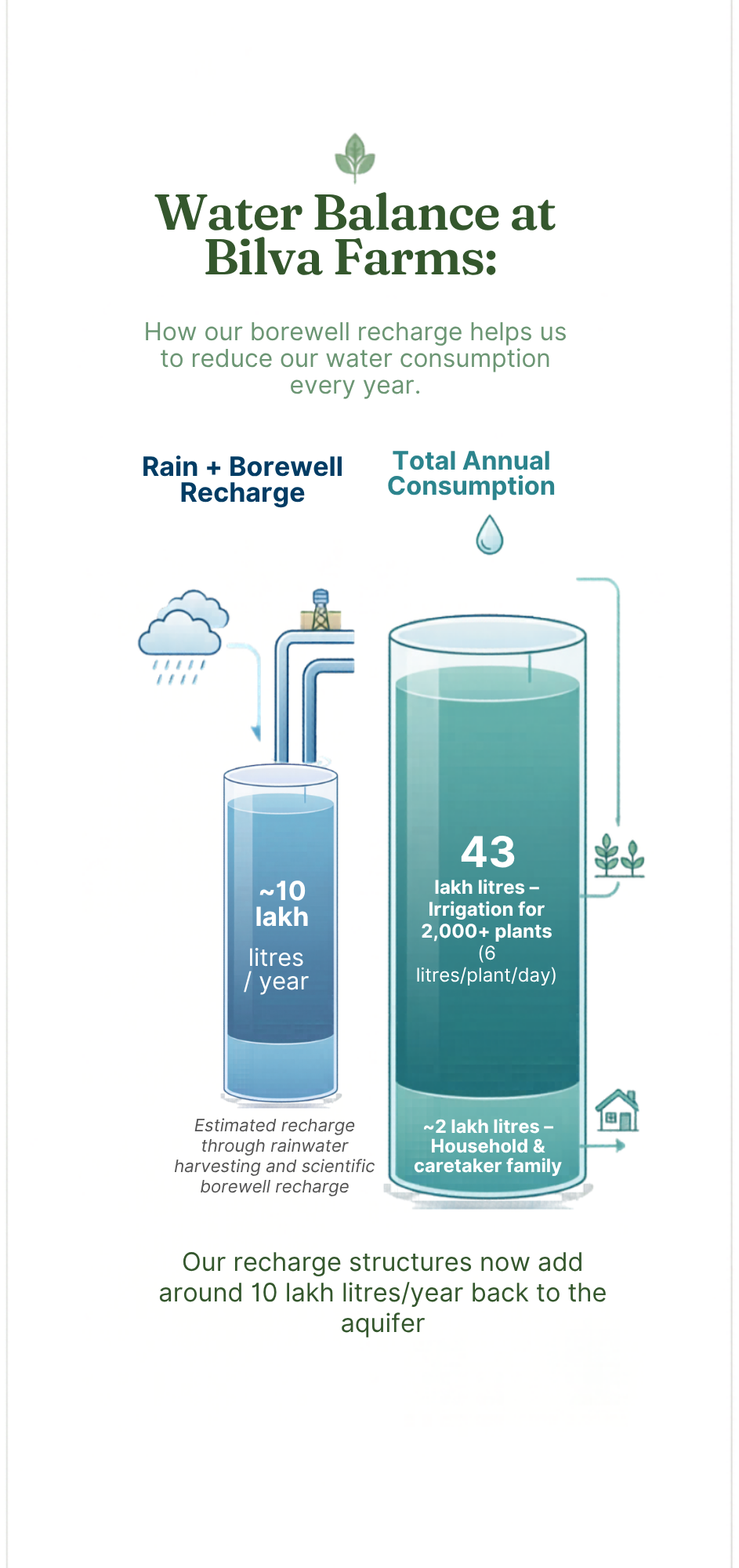
At Bilva Farms, we track our water use carefully so that our choices stay anchored in reality, not assumptions. Today, our approximate annual usage looks like this:
We provide about 6 litres of water per plant per day through drip irrigation.
With 2,000+ plants, this works out to roughly 43 lakh litres per year for irrigation alone.
Adding around 2 lakh litres per year for our caretaker’s family and household use, our total annual consumption is under 45 lakh litres of water.
With a conservative recharge estimate of ~10 lakh litres/year from our current borewell recharge work, plus the contribution from the Kapila canal and natural rainfall infiltration across the farm, we are not yet fully “net‑positive,” but we are significantly reducing the gap between what we take and what we help return to the aquifer.
Our long‑term intention is clear: as we add more recharge structures, revive another borewell, and improve the way we slow, spread, and sink rainwater on our land, we want Bilva Farms to move steadily towards a water‑balanced or even water‑positive future.
A Quiet but Important Kind of Farming
Recharging a borewell is not as visible as planting a tree or harvesting a basket of fruit, but its impact is just as real. Knowing that each summer, when our solar pump hums away to nourish our trees, the monsoon that follows is working — with our recharge structures — to refill what we have drawn gives us a deep sense of responsibility and hope.
Just like our commitment to organic fertilisers, natural pesticides, and diverse tree planting, this borewell recharge work is another way of saying: we are guests here, and we would like to leave this land, and its water, in better shape than we found it.