September 23, 2026
From an Old Oil Drum to Biochar: A DIY Soil-Carbon Experiment at Bilva Farms
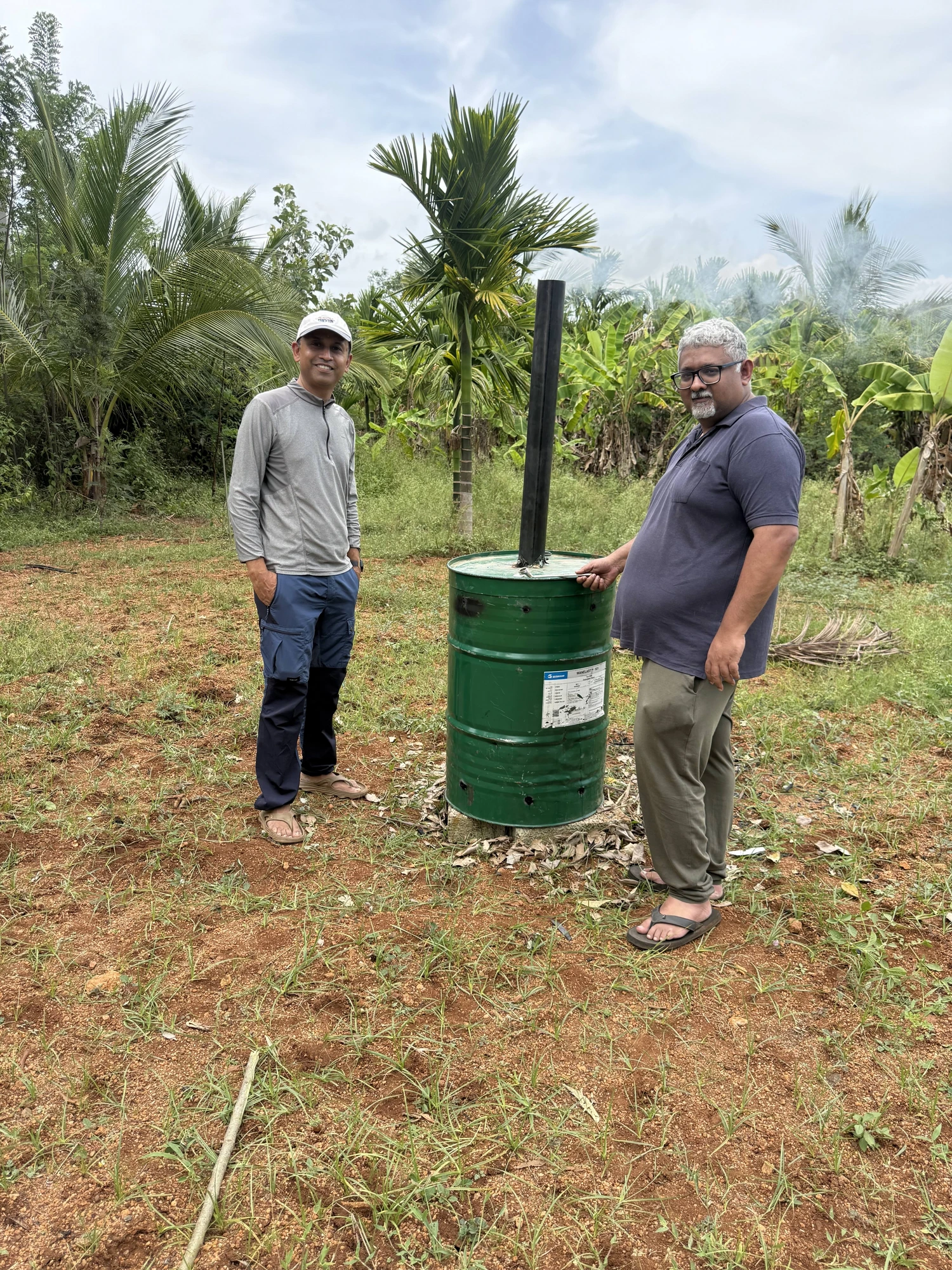
This weekend at Bilva Farms, we completed our DIY biochar experiment, turning a discarded oil drum and farm waste into a simple biochar making unit.
We found an old oil drum at a scrap yard in Nanjangud and took it to a local fabrication shop. The top was cut open and converted into a removable lid. A three-inch opening was made in the lid to accommodate a three-foot-long mild-steel chimney. Small air holes were also created near the top and bottom of the drum to help control the flow of oxygen during the process.
The idea was simple: convert organic waste into biochar through controlled burning with limited oxygen (called pyrolysis). Read more about biochar on Yale Environment 360. Read more about biochar
Our first batch consisted mainly of coconut husks, along with dry leaves collected from the farm. At the farm, the material was placed inside the drum and initially lit with sufficient airflow. Once the fire was established, the lid and chimney were fitted, restricting the oxygen supply. The burn was monitored regularly because this was our first experiment. The process took nearly 4 hours.
The results were encouraging. The dry leaves broke down almost completely into fine char, while the coconut husks retained much of their original structure and form. After the burning process, our caretaker, Veera, removed and powdered the biochar, giving us a useful material that can now be incorporated into our soil-building process.
Closing the Loop
We’re mixing the powdered biochar with our farm-made compost, which is based on well-decomposed organic material including cow dung. This creates a biochar-enriched compost that we can return to the soil. The objective is not simply to dispose of farm waste. It is to turn that waste into a resource that can contribute to soil health and increase the amount of stable carbon retained in the soil.
For now, we expect to make biochar roughly once a month, depending on the availability of coconut husks, dry leaves and other farm residues. As our young coconut trees mature and production increases over the coming year, we hope to have enough biomass to make this a more regular process.
It is a small intervention, but one that reflects what we are trying to build at Bilva Farms—using what the farm naturally produces, minimising waste, enriching the soil and becoming a little lighter on the planet.